
Wyandotte City Directory Collections
Wyandotte has several overlapping directory trails, not one uninterrupted set. Bacon Memorial District Library identifies its Polk holdings as sporadic from 1898 through 1998 and says Bressers directories continue from the 1980s to the present. Bacon's digital collection is narrower, with city-directory pages dated 1898 through 1936. The museum archive separately lists directories from 1887 through 1992. Each date should therefore be described by its actual source, whether it is a shelf volume, a digitized page, or an archive listing.
| Collection | Years | Where Held | Access |
|---|---|---|---|
| Polk city directories | Sporadic 1898-1998 | Bacon Local History Rooms | Confirm the physical volumes with library staff |
| Wyandotte City Directories | 1898-1936 | Bacon CONTENTdm collection | Free online page images |
| Museum directory listing | 1887-1992 | Wyandotte museum archive | Inquiry required for availability and copying |
| Bressers directories | 1980s-present | Bacon Local History Rooms | Confirm exact years before a visit |
Begin with the run closest to the year in question. A gap in one run is not proof that a person left Wyandotte, because the digital collection, library shelf, and museum listing do not represent the same sequence of volumes.
Bacon's Wyandotte Directory Shelf
Bacon Memorial District Library's Local History Rooms are the primary local access point for directory work. Drop-in hours are Monday through Thursday from 10:00 a.m. to 1:00 p.m., and the library also accepts an appointment or research request for a person, home, or business question. The rooms are at 45 Vinewood in Wyandotte, and the local-history librarian can be reached at 734-246-8357. Call ahead for a needed year, since a listed date span does not guarantee every volume is immediately available.
The Bacon source supports more than a surname search. Its local material includes newspapers, obituary and funeral-home microfilm, cemetery indexes, yearbooks, tax lists, photographs, clipping scrapbooks, and city primary-source documents. Those companions help test an address change or a similar set of initials. They do not turn a directory entry into proof of a person's full household or later address.
The Bacon Local History source documents the rooms and their research services.
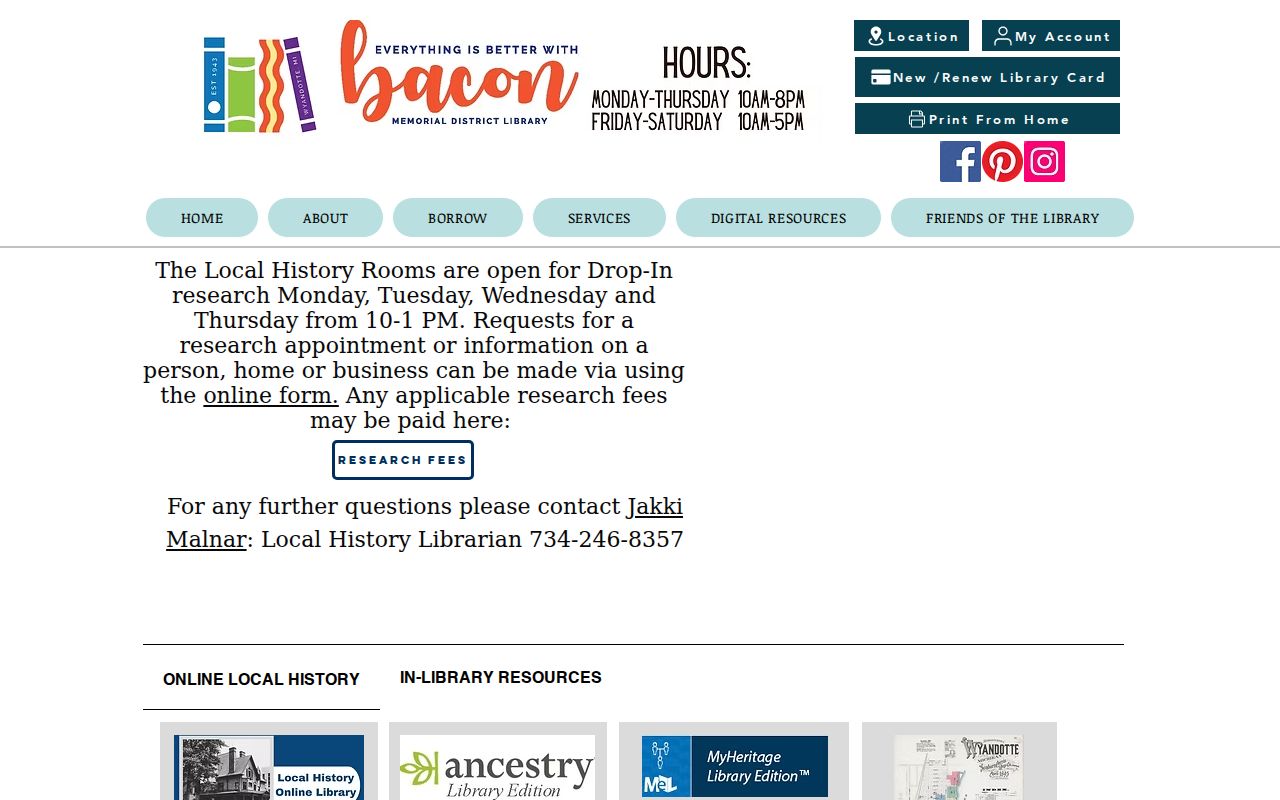
Bring the street name, a rough year, and spelling variants so staff can direct the search to the most useful shelf volume or supporting source.
Digitized Wyandotte Directory Volumes
The Wyandotte City Directories collection in Bacon CONTENTdm identifies its digital run as 1898-1936. Page images make it possible to inspect a name in the context of its printed page, rather than rely only on a transcription. Look at neighboring entries, street abbreviations, and the volume's front matter before deciding what a symbol means. Scan completeness can vary, so a missing online page should be checked against the library shelf.
The digitized run is especially useful between federal census dates. It can indicate that a surname appeared at an address in a particular directory year, while the census gives a separate household snapshot. Neither one should be used to fill a missing year by assumption.
The CONTENTdm directory collection is the source for the online volume images.
Save the volume year and page reference with every finding, because an initial or a notation can be interpreted differently from one printed volume to another.
Wyandotte Museum Directory Listing
The Wyandotte museum archive reports city directories for 1887-1992, along with Michigan state censuses from 1855-1925, owner-attributed maps and plat maps from 1870-1923, surname files, telephone directories with gaps, and other family-history material. This makes the museum a useful second channel when the digital collection ends or a street needs map context. The archive page does not promise that every listed item is digitized, open for copying, or available on a particular day.
Ask the museum about the precise directory year, any appointment requirement, and reproduction options. That confirmation matters most at the start and end of a listed run, where a broad date range can hide a missing volume.
Note: Museum holdings should be requested by collection and year, not treated as a complete online sequence.
Reading Wyandotte Directory Entries
A local genealogy transcription gives a rare sample from 1898-1899: “Mrs. R. F. Johnson h 119 Fifth Street.” It is a secondary transcription, so the page image or shelf volume should be checked before quoting it as a primary source. What the sample actually shows is limited. It visibly contains an honorific, initials, a name, an h mark identified by that source as homeowner, and a street address. It does not establish an occupation, employer, spouse, telephone number, or a full abbreviation key.
| Honorific | “Mrs.” appears in the inspected sample. |
|---|---|
| Initials | “R. F.” appears before the surname. |
| Name | Johnson is the visible surname in the sample. |
| Homeowner mark | The source identifies h as a homeowner mark for this sample. |
| Address | 119 Fifth Street is visible in the sample. |
- Criss-cross directory
- An address-ordered directory that can lead from a street number to a listed name. Bacon's public description does not confirm a separate standalone criss-cross series.
- Householder index
- A name-oriented arrangement for locating the person or household under which an entry was printed. Its presence must be checked in the particular volume.
- Abbreviation key
- The printed explanation for shorthand used in that volume. Photograph or note it first, because a mark should not be guessed from a different year.
Wyandotte Directory Street Aliases
Old street language can produce a false break in a city-directory search. Wyandotte's official street-history archive says early streets were laid out roughly parallel to the Detroit River with numbered streets, and that Front or First later became Van Alstyne Boulevard for the city's first mayor. A Fifth, First, or Front reference should be searched as a historical alias, then checked against nearby numbers, a plat map, or the verified map source before being matched to a current address.
That local street pattern also explains why a simple modern-address search can miss a household that remained on the same parcel. For current address-keyed records, use the separate Wyandotte streets search route after the historical name has been reconciled.
Note: A street-name change, numbering change, or initial-only entry is not evidence by itself that a family moved.
Tracing Wyandotte Directory Households
City directories are strongest when followed year by year rather than read as a one-time answer. Start with the earliest confirmed spelling, then preserve every initial, honorific, and address form exactly as printed. Match those observations to a census date and to the street form in use at the time. Federal census releases follow a 72-year rule, and 1950 is the latest generally public federal census as of this research date. The museum reports local Michigan state-census holdings for 1855-1925, which may provide another time marker.
- Locate the surname or initials in one dated volume and record the full printed address and any mark that is defined by that volume.
- Check the volumes immediately before and after it, using both the surname and alternative initial forms.
- Search the address or street order only when the volume contains such an arrangement or the library identifies a related criss-cross source.
- Pair the directory observation with the nearest public census year, keeping the directory address and census household as separate records.
- Use a dated newspaper notice, cemetery index, obituary, or probate file to investigate a disappearance from the run.
A directory disappearance can reflect a move, death, an unlisted household, changed initials, a renamed street, or a publication gap. Comparing several independent dates is safer than selecting the first explanation that fits.
Wyandotte Directory Gaps
Directory research needs an explicit gap log. Polk is described as sporadic, the online run ends in 1936, and the museum's 1887-1992 listing requires direct confirmation. Bacon's Wyandotte Herald descriptions also differ by format: the digitized collection describes 1880-1943 with many missing nineteenth-century issues and incomplete 1943 coverage, while a microfilm listing begins in 1895. An absent name in a searchable image is therefore not the same thing as an absent name in all local sources.
When a question reaches beyond the local shelf, the Archives of Michigan visit information describes an in-person route with open stacks for books and microfilm, public computers, and staff retrieval for archival records. Photo ID is required, and bags, pens, and cameras are not allowed in the viewing area. Library and microfilm digital copies are free; the published copy rules list paper and archival copies at $0.20 per page up to $3 for 15 pages.
The Archives visit source explains the reading-room rules for records that are not digitized.
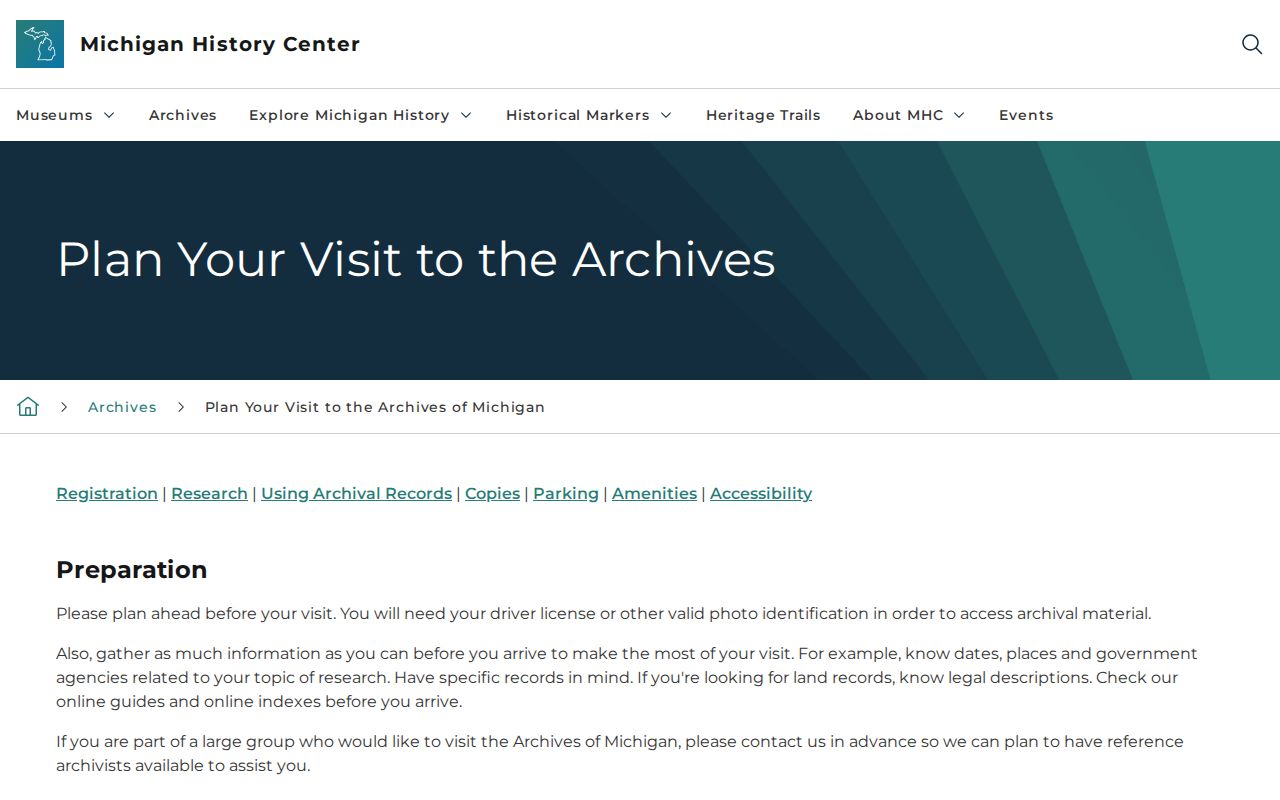
Those archival holdings include Wayne County probate groups and Wyandotte tax records, which can anchor a family or property question when the city-directory trail stops. The county guide identifies probate calendars from 1797-1914, case files from 1797-1901, and estate files from 1901-1968. These are dated archive groups, not a substitute for a directory entry.
Wyandotte Directory Companion Records
Newspapers and local indexes can clarify a move, death, or name variation without being substituted for the directory itself. Bacon lists Thon Funeral Home microfilm for 1921-1995 and local death-record microfilm for Wyandotte from 1897-1998. It also lists yearbooks and cemetery indexes. An obituary may provide a useful lead about relatives, a former address, service location, or burial, but the underlying newspaper image or an official record should be checked when the fact matters.
For the oldest property context, the Archives of Michigan guide lists Wyandotte tax assessment rolls for 1868-1911 and delinquent-tax material from 1869. The local directory, tax, map, census, and obituary layers describe different moments and roles. Keeping them separate makes a family-history timeline much more reliable.